One connected inventory
Cloud resources, identities, networks, applications, data and software components align to the same organisational model while retaining their source.
Connect posture, identity, network, data, vulnerability and AI evidence in Orion's shared ontology. Understand what an attacker could reach, why it matters and which change reduces the most risk.
 OrionShared ontology
A public endpoint, an over-privileged identity and sensitive data may each sit in a different tool. Orion brings the evidence together so Exposure Management can evaluate the combination—not only the individual alerts.
Cloud resources, identities, networks, applications, data and software components align to the same organisational model while retaining their source.
Posture findings gain reachability, privilege, exploitability, data sensitivity and business context from the surrounding graph.
Prioritise the change that breaks an attack path or reduces the most realistic exposure, with evidence showing why.
Each module reads from the same ontology and contributes context to the same finding queue, exposure score and attack-path graph.
Assess configuration, operational and secret findings across AWS, Microsoft Azure and Google Cloud accounts, subscriptions and projects.
Understand people, groups, guests, service accounts and workload identities: how they authenticate, what they can do and what compromise would reach.
Model networks, firewalls, routes, clusters and sites to show effective reachability rather than assumed connectivity.
Connect where sensitive data lives to its classification, ownership, access and infrastructure context.
Correlate scanner evidence into one affected asset and rank vulnerabilities using exploitation, reachability and impact—not CVSS alone.
Connect repositories, pipelines, runners, dependencies and deployment identities from source code to production.
Bring applications, APIs and security testing into the same model as the workloads and data they support.
Inventory AI models, endpoints, agents, tools and MCP servers, then connect them to identities, data and infrastructure.
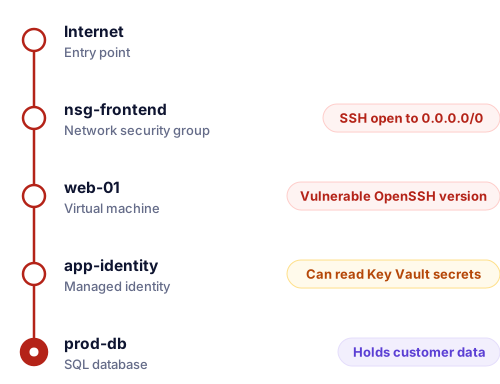
Exposure Management joins effective network reachability, identity permissions, vulnerabilities and target context. A finding can show the chain from a public service through a workload identity to the database or secret an attacker could reach.
Traditional AI posture stops at model and endpoint configuration. Orion connects agents and MCP tools to the identities they execute as, the resources those identities can change and the sensitive data they can retrieve.
Illustrative potential path. Orion distinguishes configured capability, effective permission and observed behaviour so potential exposure is not presented as a confirmed incident.
Connectors bring read-only evidence into the Integration Bridge. The ontology aligns each source to one extensible model. Exposure engines then derive findings, scores and paths without discarding provenance.
Shared ontologyYour assets and relationshipsHow the product connects evidence, prioritises work and grows with your organisation.
No. The capability modules share Orion's inventory, ontology, finding queue, exposure score and attack-path graph. Cloud, identity, network, data, vulnerability, development, application and AI evidence can therefore reinforce one another.
Priority can combine technical severity with evidence such as known exploitation, internet exposure, effective reachability, identity privilege, sensitive-data impact, business context, fix availability and confidence.
Data Security Posture, Development Security Posture, Application Security Posture and AI Security Posture are currently marked preview. Preview status is shown explicitly while coverage and integrations continue to mature.
Yes. Orion's ontology can be extended with your applications, business services, ownership, classifications and other relationships. Products then analyse the model shaped around your organisation rather than forcing every customer into the same schema.
Tell us which clouds, identity providers, networks, scanners and security sources your teams use today.