Discovery is fragmented
Cloud inventories miss certificates embedded in workloads; filesystem scans miss the cloud service, identity or application that gives each asset meaning.
Build a connected inventory of certificates and cryptographic keys across cloud and workload sources. Prevent expiry surprises, expose ownership gaps and turn post-quantum readiness into an evidence-based migration plan.
Cryptographic assets are spread across app registrations, cloud services, workload disks, key stores and appliances. Expiry dates alone do not explain service impact, renewal ownership or the scale of post-quantum migration.
Cloud inventories miss certificates embedded in workloads; filesystem scans miss the cloud service, identity or application that gives each asset meaning.
A renewal alert without an accountable person, team or owning service creates a ticket that can still become an outage.
Knowing an algorithm is vulnerable is only the start. Migration depends on lifespan, dependencies, exposure and which systems can change together.
Certificate Intelligence uses Orion's ontology to connect every discovered asset to the identities, workloads, services and owners around it.
Bring certificates and keys from supported cloud and workload sources into one consistent inventory while preserving provenance.
Derive ownership from the application, identity and organisational relationships already represented in Orion.
Find expired and expiring certificates, distinguish managed lifecycle from customer action and focus renewal work where interruption is possible.
Classify algorithms and key strength, identify long-lived quantum-vulnerable cryptography and plan migration using real dependencies.
Orion separates cryptography that is weak today from cryptography expected to be vulnerable to a sufficiently capable quantum computer. It highlights long-lived assets that may survive normal renewal cycles and connects them to the services that must migrate.
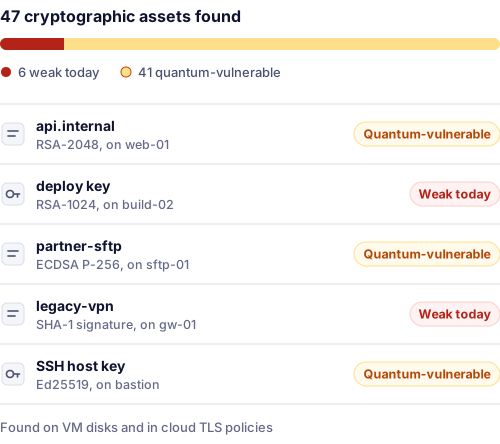
Any connector that maps certificates or keys into Orion can feed the product. Certificate Intelligence then links holders, owners, workloads and services before applying lifecycle and quantum-readiness analysis.
 Orion relationshipsHolder · owner · workload · dependency
Certificate Intelligence relates a cryptographic asset to the identity or service that holds it, then uses Orion's organisational relationships to identify the people responsible. Unowned certificates remain visible as a distinct operational risk.
What is discovered, how ownership works and how the product supports post-quantum planning.
The product is designed around certificates and keys, including X.509 certificates and SSH key material discovered through supported sources. Coverage depends on the connectors and scanning options enabled for your environment.
No. Where agentless disk scanning is enabled, temporary snapshots and scanning resources are used within the authorised cloud workflow. The product receives structured findings and cryptographic metadata rather than retaining raw disk contents.
Orion connects a certificate to the identity, application or service that exposes it, then follows management and ownership relationships to the responsible person or team. Assets without a reliable owner are kept in an explicit unowned view.
Not necessarily. The product distinguishes cryptography that is weak today from conventional algorithms expected to be vulnerable to future quantum attack. Lifespan and dependency context help determine migration priority.
Start with the cloud, identity and workload sources where expiry or cryptographic visibility matters most.